For rapid-acting insulin users
Carb counting with CosMeal when you take rapid-acting insulin
For people who take rapid-acting insulin with meals: how to get a carb count you can use, from a photo, a note, or a nutrition label.
Who this guide is for
If you take rapid-acting insulin with meals, you count the carbs in every meal, because your mealtime insulin dose is ultimately based on that number. Your care team sets the plan and tells you how to use the count.
CosMeal helps with the counting. It reads your meal from a photo, a note, or a nutrition label, and gives you the grams of carbs. CosMeal counts carbs. It does not calculate insulin.
This guide follows a meal from start to finish: the photo, the note, packaged food and recipes, then how to read the numbers the app gives you.
Take a photo the app can read
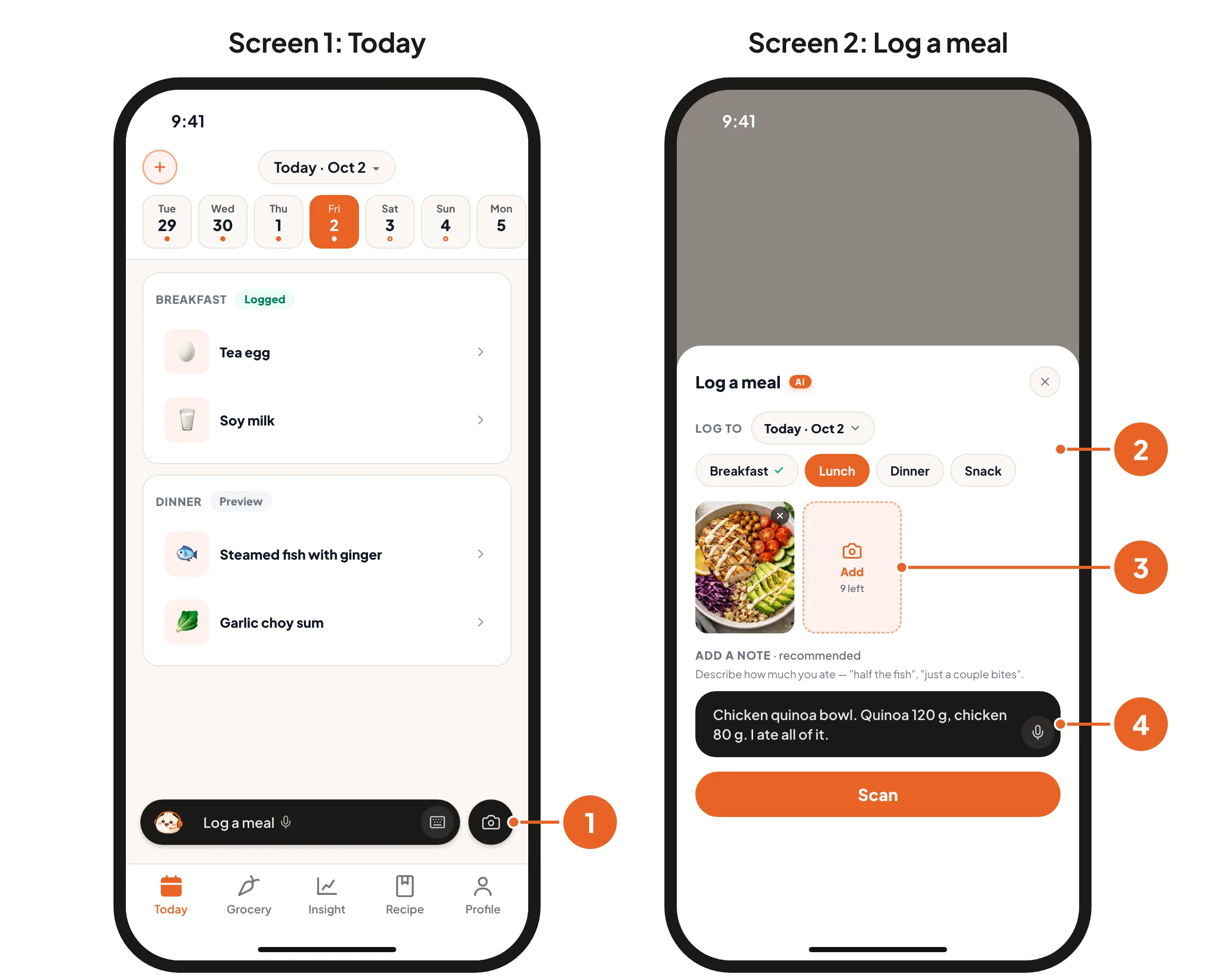
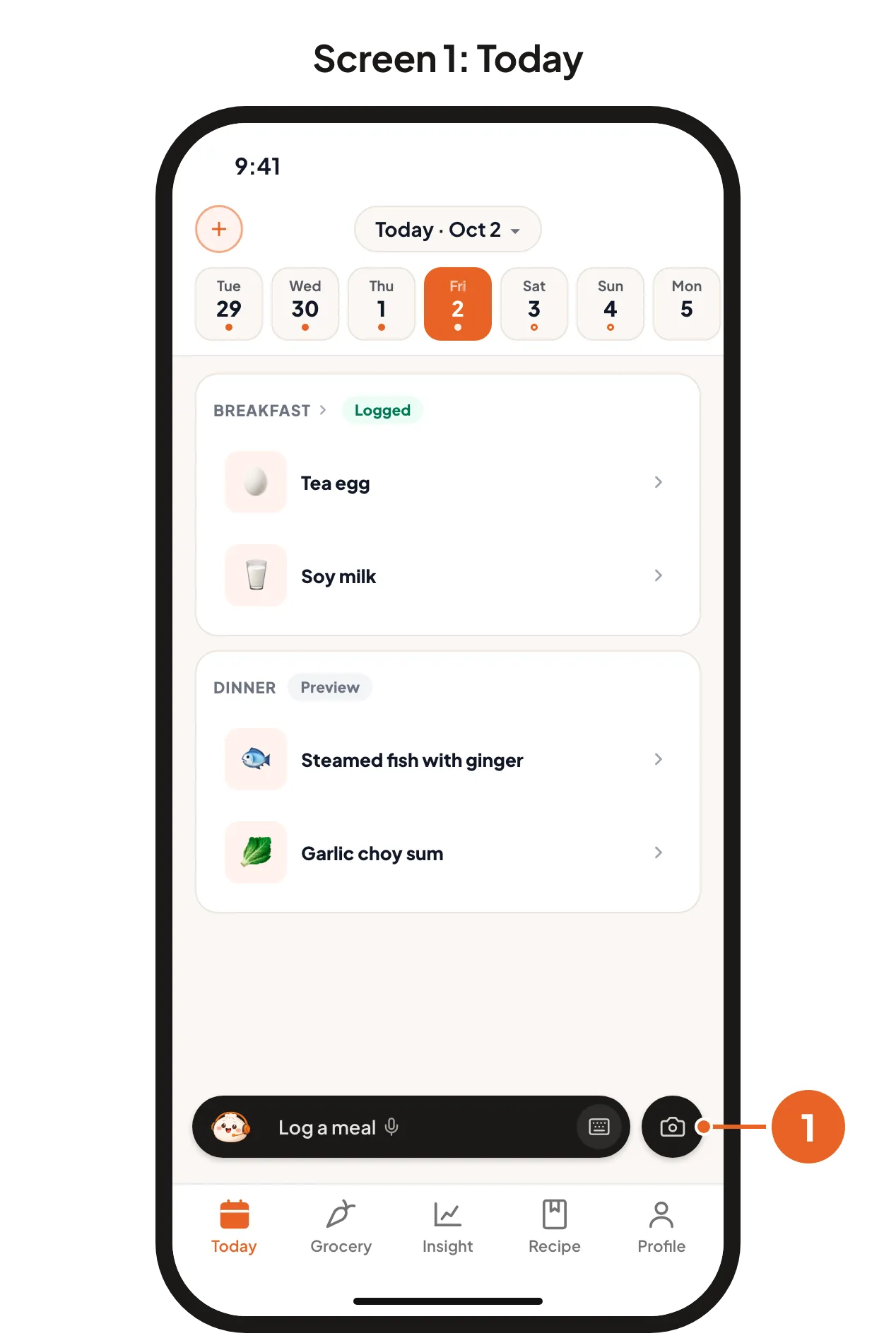
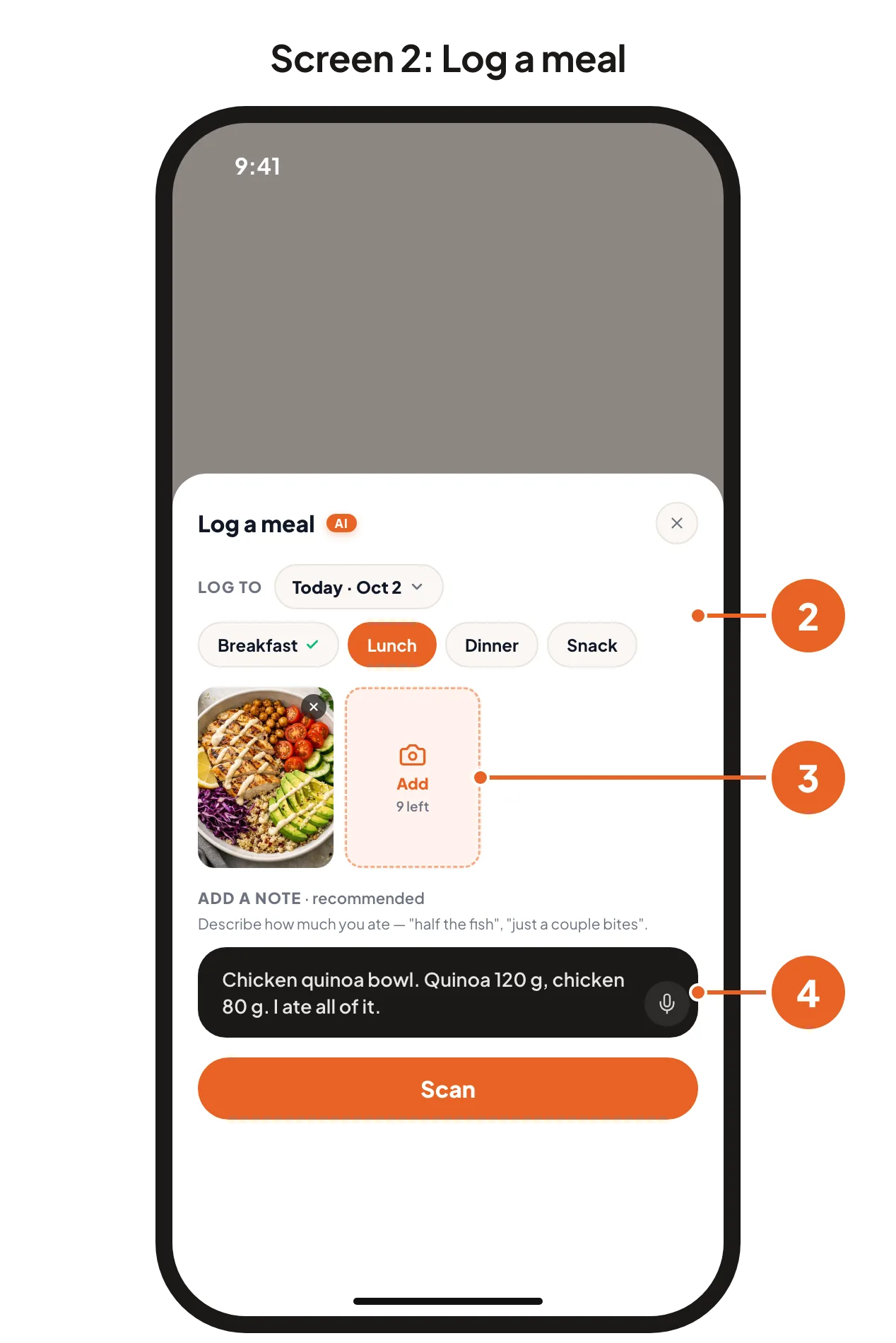
- Keep the whole plate in the frame, in good light.
- Take one photo of the whole meal, or one photo per dish, up to 10.
- Sharing dishes at a family dinner? Log only what is on your own plate, and say how much you took.
- Log before you eat, so the count is ready when you need it.
How accurate is a photo?
Judging food by eye is hard, even for experts. In the study behind the Nutrition5k dataset, 4 professional nutritionists judged the weight of the food on 10 plates from photos. On average they were off by 41%. 16 people without training were off by 53%.
We based CosMeal's estimates on 280 plates from the same dataset, where every food was weighed, and scored on those plates. The score is out of 100: 100 means the estimate matches the weighed food, and 80 means it is 20% off. The score goes up most when you tell the app more:
| What you give | Example | Score | Carb error |
|---|---|---|---|
| Photo only | No note | 69 | 7.5 g |
| Photo + food names | “Chicken, rice and broccoli” | 74 | 6.2 g |
| Photo + everyday amounts | “Half a bowl of rice, two eggs” | 83 | 4.5 g |
| Photo + weights | “Rice 120 g, chicken 60 g” | 87 | 3.5 g |
| Nutrition label photo | The app copies the printed numbers | 100 | — |
Carb error is the average difference from the weighed carbs, per plate. The plates were photographed from above in a cafeteria; your own photos may score higher or lower. The nutritionists judged portion weights on 10 plates, so compare the two only roughly.
A photo cannot show weight, oil, sugar or sauce, so a photo alone has a limit. And when the app has to judge the amount from a photo, it leans a little low on purpose, to stay on the safe side.
Add a note: what it is, and how much
The note is where the accuracy comes from. You can type it or say it.
- Good: name the food, for example “brown rice and chicken”.
- Better: say how much, for example “half a bowl of brown rice, two eggs”.
- Best: give the weight, for example “brown rice 120 g, chicken 60 g”. When every food in a dish is weighed, the app uses your weights as they are, and the dish shows one number instead of a range.
Weigh it once
A kitchen scale takes a few seconds. Weigh your usual bowl of rice or plate of noodles once, and after that you can write the weight from memory.
Dry or cooked
Weighing your carb portion, either dry (uncooked) or cooked, will greatly help CosMeal's accuracy. Rice, pasta and noodles soak up water as they cook, but their carbs stay the same. If you weigh them before cooking, write “dry” in the note, for example “noodles 52 g dry”.
Sauces
Home cooking hides carbs in the sauce. The app already counts the sauce as part of the dish, but naming it helps. Add sauces after your weights, in spoons: “noodles 52 g dry, chicken 80 g, bok choy 100 g, 1 tablespoon oyster sauce”. The sauces most worth writing down are the sweet or thick ones: oyster sauce, hoisin sauce, sweet and sour sauce, and anything thickened with cornstarch. Soy sauce adds very few carbs.
Packaged food: photograph the nutrition label
For anything with a Nutrition Facts table, take a photo of the table itself with the same camera. There is no special mode: the app recognizes the label and copies its numbers, so the result shows single numbers, not a range.
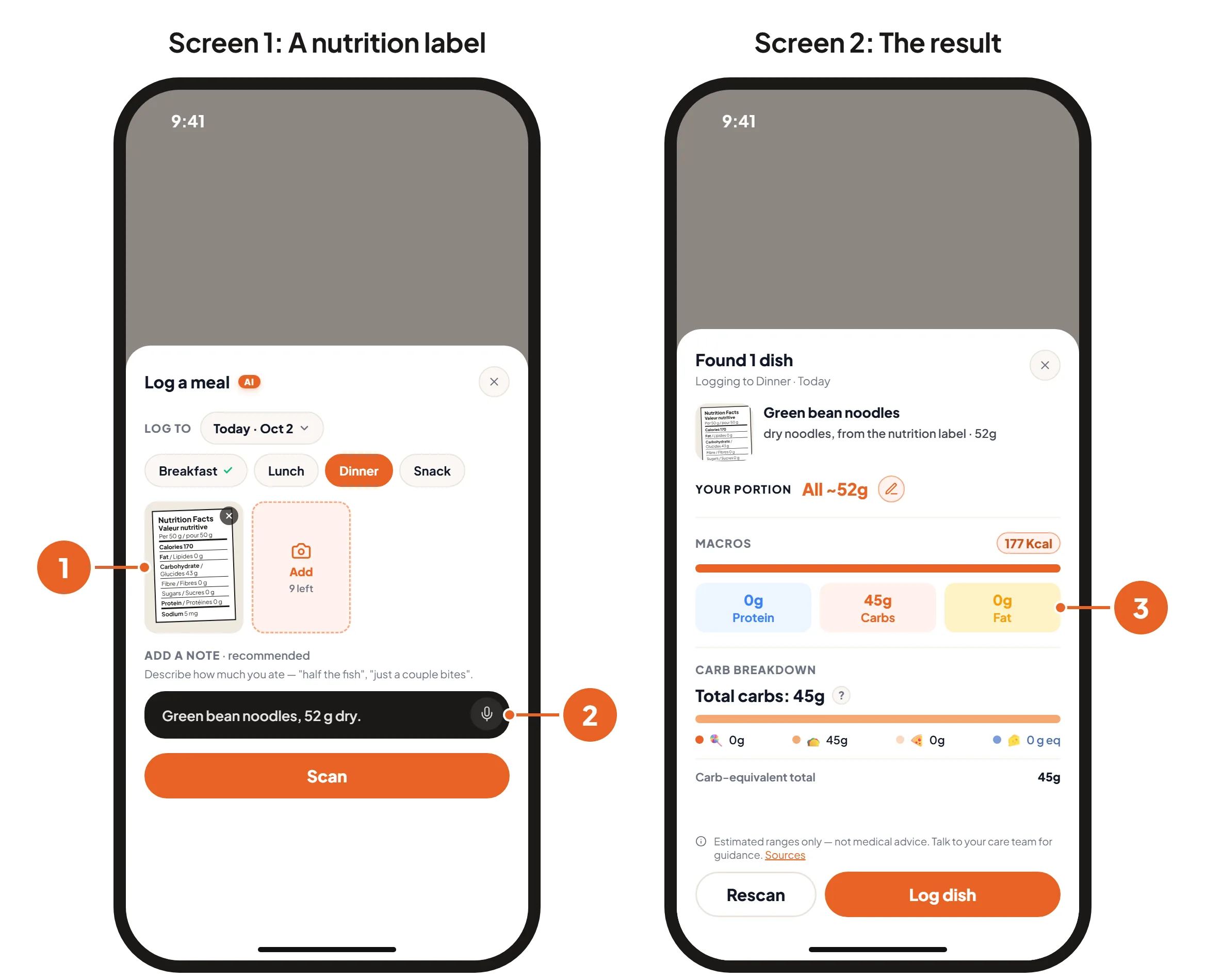
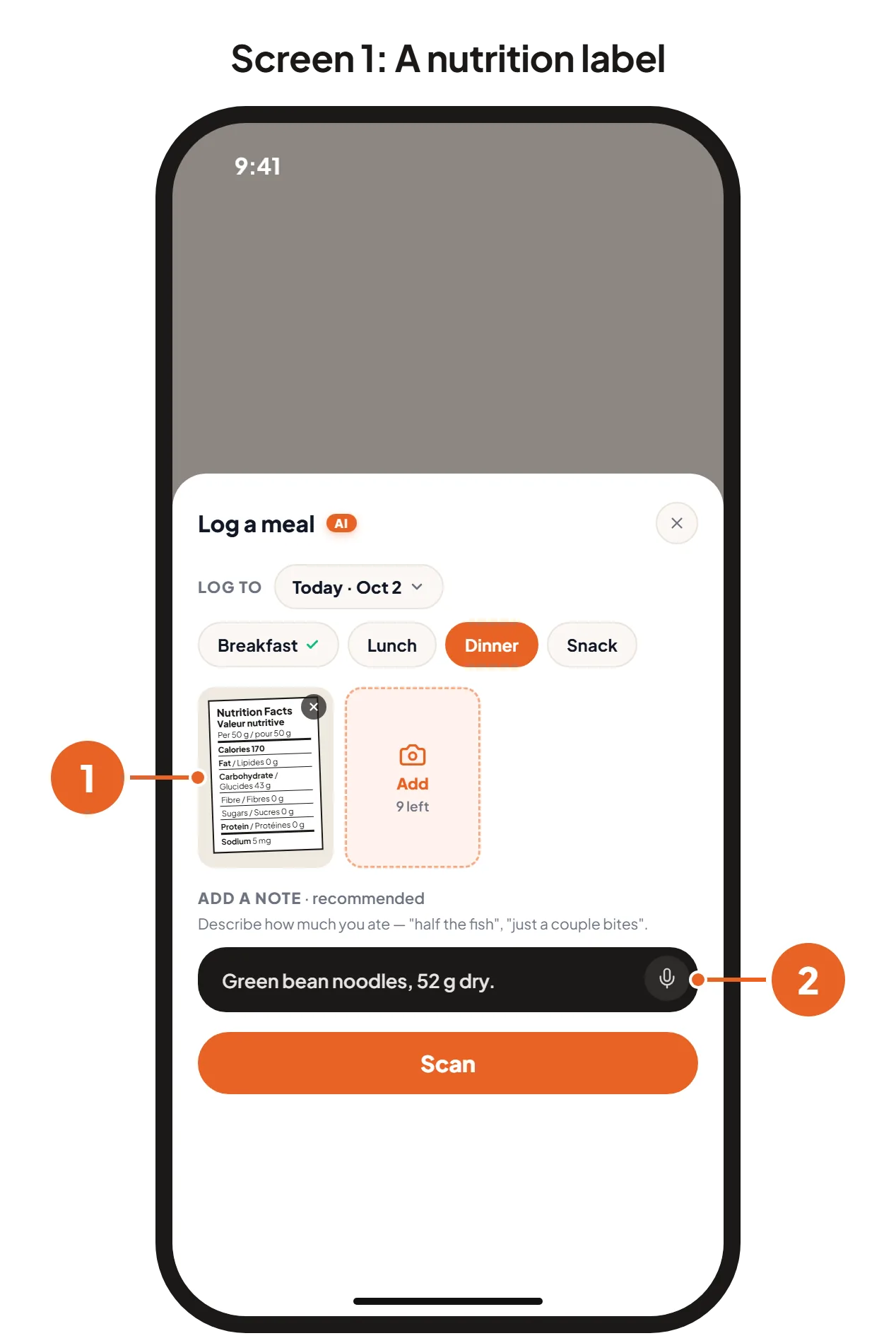
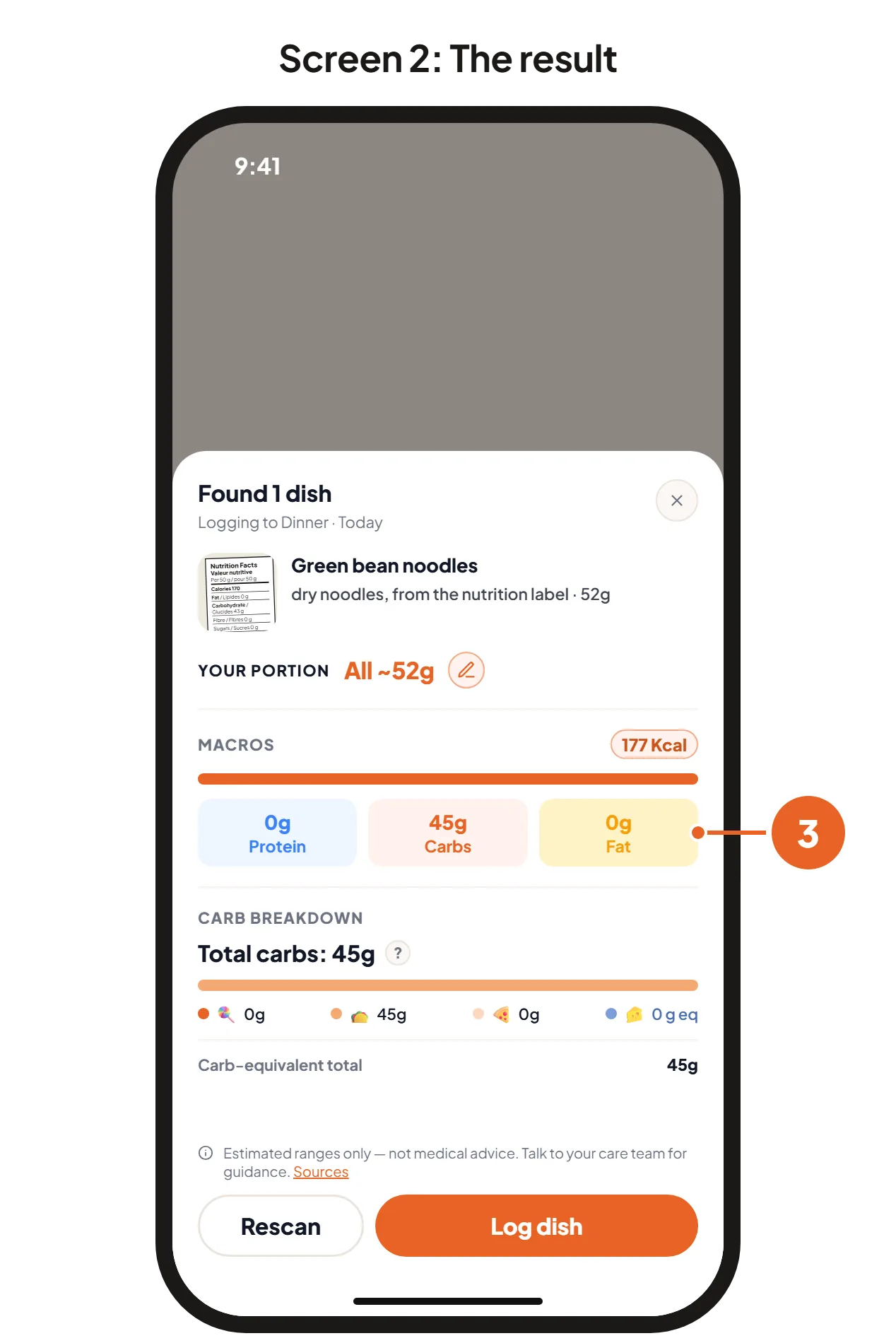
Without a note, the app counts one serving as printed on the label. If you ate a different amount, say so in the note: “2 servings”, “the whole bag”, or a weight such as “52 g dry”. Keep the whole table in the photo and in focus; if the label is blurry, the app estimates the food instead.
Want to cook noodles for a set amount of carbs, say 45 g? Baobao, the app's AI assistant in the bar at the bottom of Today, can work out how much to weigh. It can't read a photo in the chat, so type the numbers from the label: “My noodle label says 50 g has 43 g of carbs. How many grams of dry noodles give me 45 g of carbs?”
Fiber
On Canadian and US labels, the carbohydrate line includes fiber. CosMeal's Total carbs leaves fiber out, so it can be lower than the label. Many diabetes educators teach this way of counting. The American Diabetes Association suggests counting the label's total carbohydrate, fiber included, and watching your own response. Ask your care team which suits you.
Cooking from a CosMeal recipe
When you cook a dish from your CosMeal meal plan, the app knows every ingredient and its weight. It uses the recipe's numbers instead of guessing from the photo. Just tell it how many servings you ate. This is the most accurate way to log home cooking.
Read the result
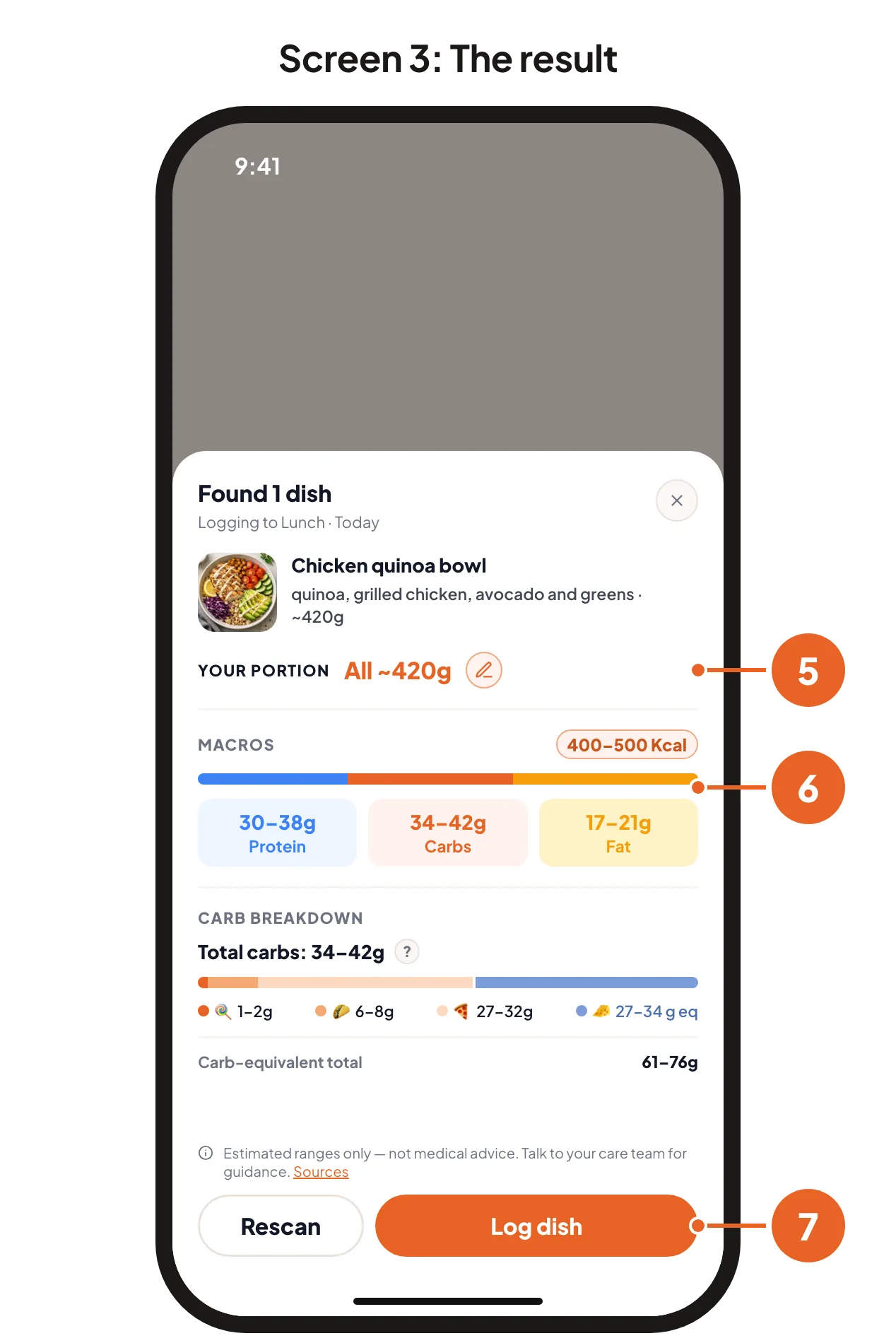
Which number to use with your insulin is a question for your dietitian or diabetes team. They know your insulin plan and can help you decide.
If the app named a food wrongly, tap Rescan, fix the note and scan again. Your photos are kept.
Add up the whole meal
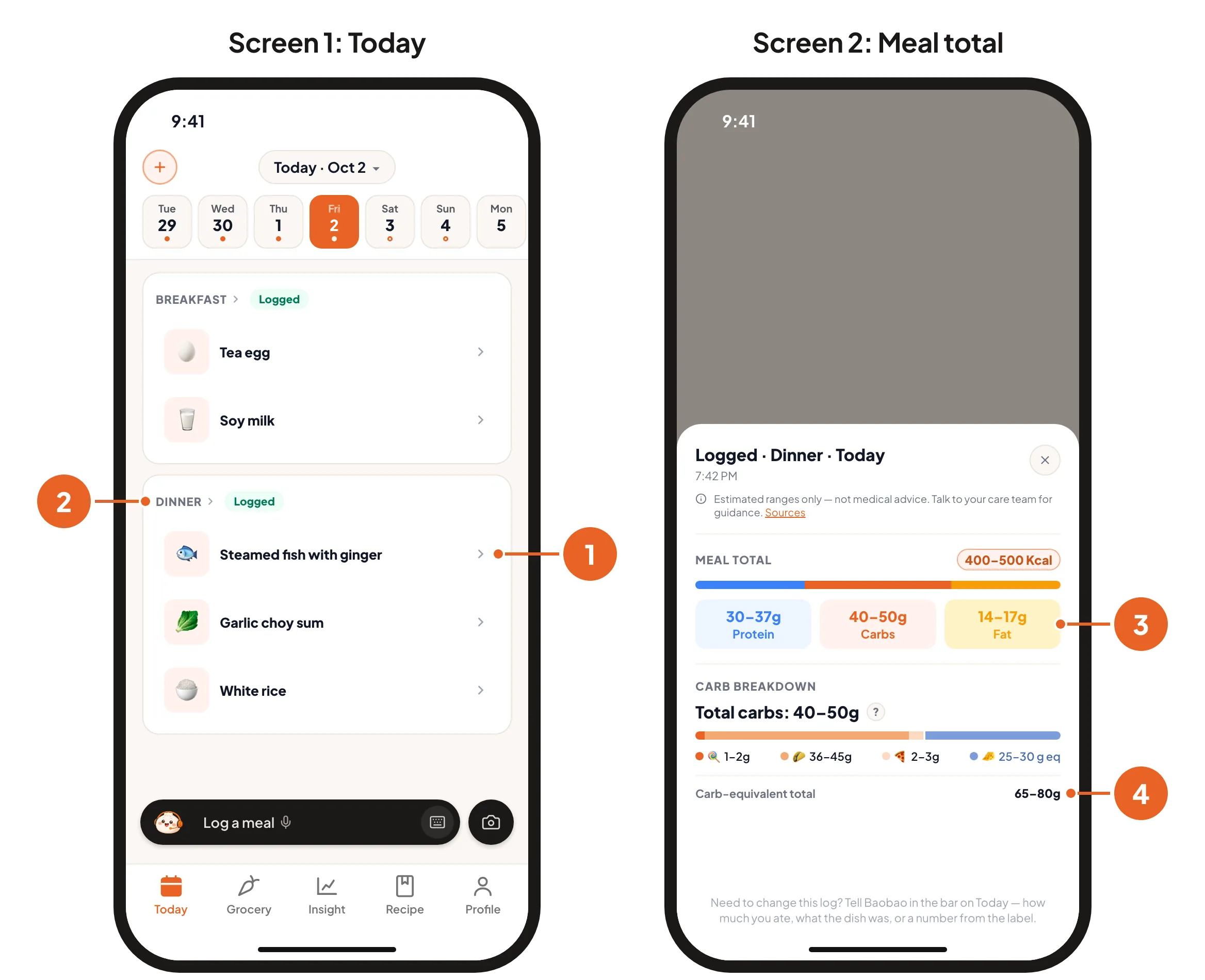
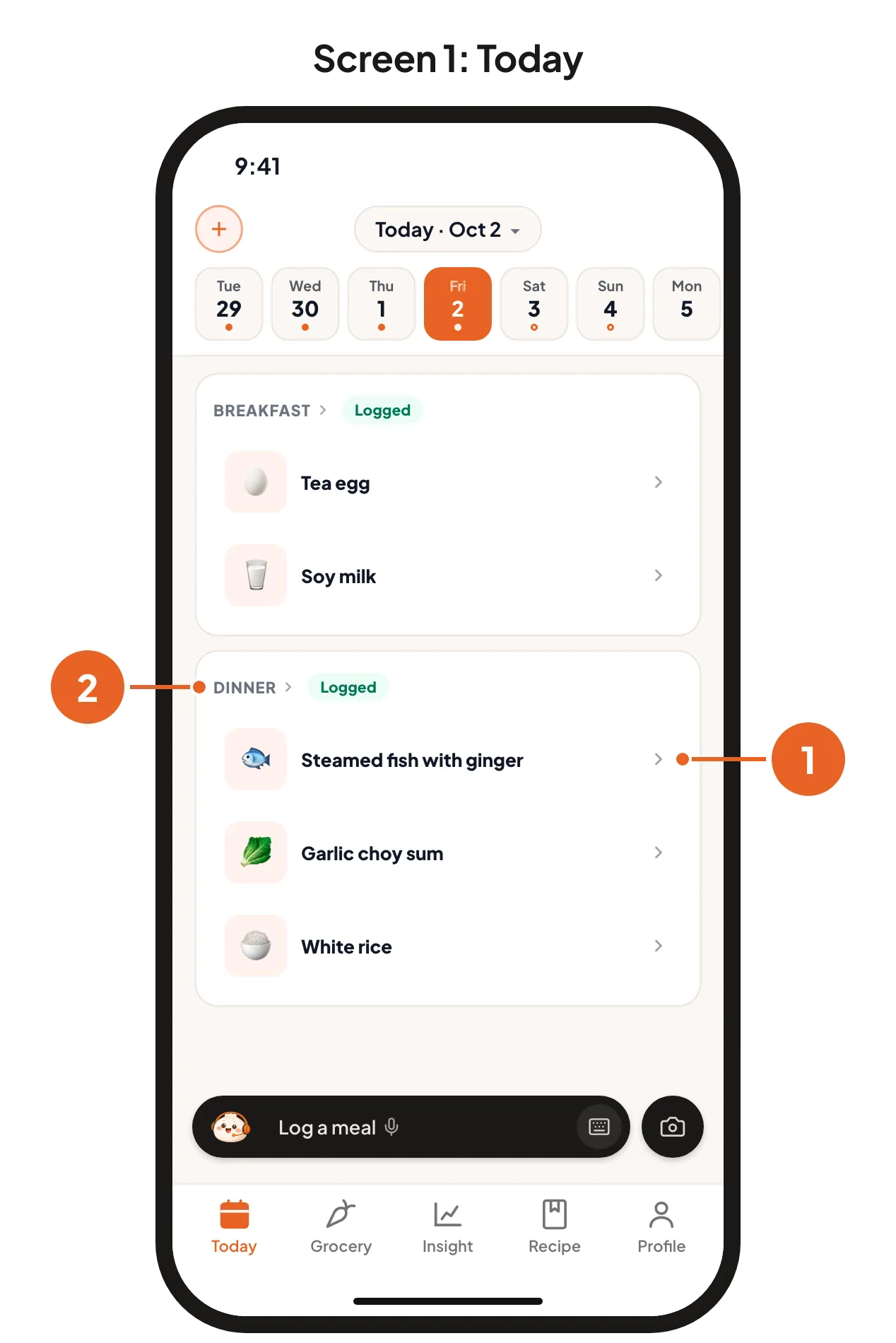
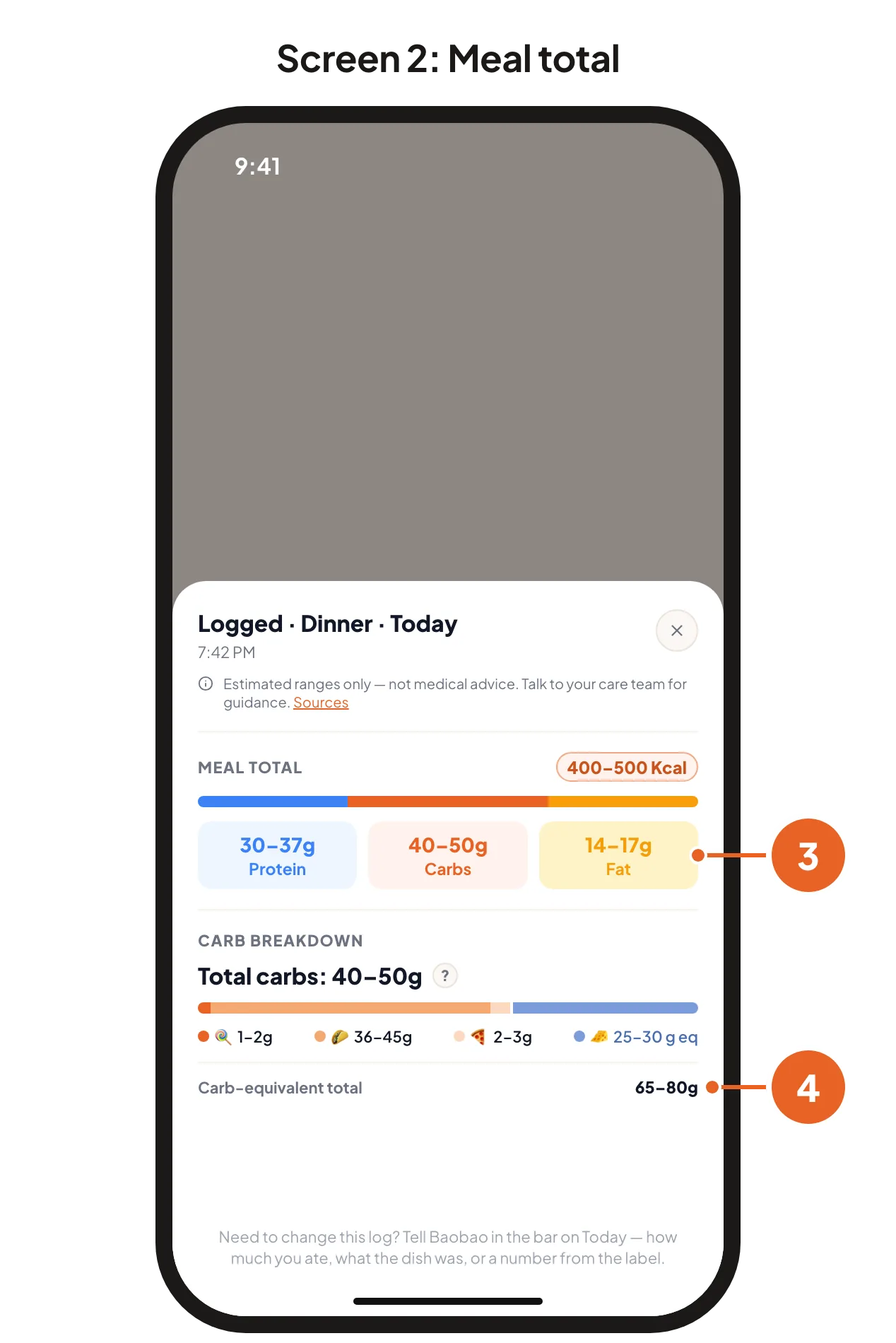
You don't need to add up dishes by hand. On Today, tap the meal's name, such as DINNER ›, and the Meal total adds every dish together. Snacks are not added together.
Tap a single dish to see its own numbers and the time you logged it, which helps when you compare with your sensor readings.
Total carbs or carb-equivalent total?
The carb card shows 2 totals. Total carbs is the number for your mealtime carb count. Do not add the protein and fat equivalent to it.
Carb-equivalent total also counts protein and fat. They raise blood sugar too, but later and more slowly, about 3 to 8 hours after eating. CosMeal uses the Warsaw fat-protein unit method: 100 kcal of protein and fat counts like 10 g of carbs.
After a meal high in protein or fat, such as steak or fried food, your blood sugar may rise a few hours later, even when the carbs were low. Watch for it on your meter or sensor, and if you see it often, talk to your diabetes team.
Fast, medium and slow carbs
The result also splits the carbs by how fast they are absorbed. The glycemic index ranks single foods eaten on their own. CosMeal turns the same idea into grams for your own portion, and in a Meal total it also counts how the fat, protein and fiber in one dish slow down the carbs of another:
| Speed | Absorbed within | For example |
|---|---|---|
| 🍭 Fast | 30 min | Sugar, candy, white bread, juice |
| 🌮 Medium | 3 hr | White rice, pasta, tacos, potatoes |
| 🍕 Slow | 5 hr | Pizza dough, whole grains, legumes, fiber-rich foods |
So in a Meal total, the split can differ from adding up the dishes, with more of the carbs in medium and slow. Total carbs stays the same.
Check, learn, adjust
- Check your blood sugar a few hours after meals. If it is often too high or too low after the same kind of meal, tell your care team.
- Weigh your food now and then, even if you usually estimate, to keep your eye sharp.
- If a number looks wrong, add detail to the note and scan again rather than guessing around it.
Sources
- Thames Q, et al. Nutrition5k: towards automatic nutritional understanding of generic food. CVPR 2021.
- Nutrition5k dataset, Google Research.
- Pańkowska E, et al. Application of novel dual wave meal bolus and its impact on glycated hemoglobin A1c level in children with type 1 diabetes. Pediatr Diabetes. 2009;10(5):298–303.
- Smart CE, et al. Both dietary protein and fat increase postprandial glucose excursions in children with type 1 diabetes, and the effect is additive. Diabetes Care. 2013;36(12):3897–3902.
- Atkinson FS, et al. International tables of glycemic index and glycemic load values: 2008. Diabetes Care. 2008;31(12):2281–2283.
- American Diabetes Association. Carb counting and diabetes.